Friday, May 6, 2011

Chowigna Villages

Under some condominiums built in the Malaga Cove area of Palos Verdes, very near Torrance, are the remains of villages that date back over 7000 years. Yes, seven thousand. People were living there and eating raw shellfish.

At various times over the millennia, other groups made their homes there. The most recent prehistoric settlers were a branch of the Tongva people called Chowigna. The Malaga Cove site was excavated in 1936-37 by the Southwest Museum and USC, and thousands of artifacts were catalogued.

The picture here is of a Santa Fe Springs Interpretive Center model home--I borrow it from one Tongva tribal website (there is more than one).

The Tongva lived in Palos Verdes from around 1000 AD to around the mid-1700s. They used pots and ornaments made from soapstone from Catalina Island--proof of a flourishing trade. Other villages dotted the Peninsula--Archaeologist William Wallace told the LA Times in 1971 that he knew of at least 70 sites, though he hadn't excavated all of them.

The Tongva villagers left behind glass beads, traded from the Spanish, and shortly after that the village was abandoned when at least 150 people (possibly the entire village population) were taken to the Mission San Gabriel.

All this and a bit more are in an article I wrote for Patch.com that ran last Monday. Wikipedia also has a  lot of info about Tongva villages.

The most intriguing bit of information I learned is that the largest village in the area. Suang Na, was on Lake Machado in Harbor City--but nobody knows exactly what side of the lake. It hasn't been found or excavated, iow. I'm not suggesting anyone start digging now, but it is nice to know that there is lots for us still to learn.

Monday, May 2, 2011

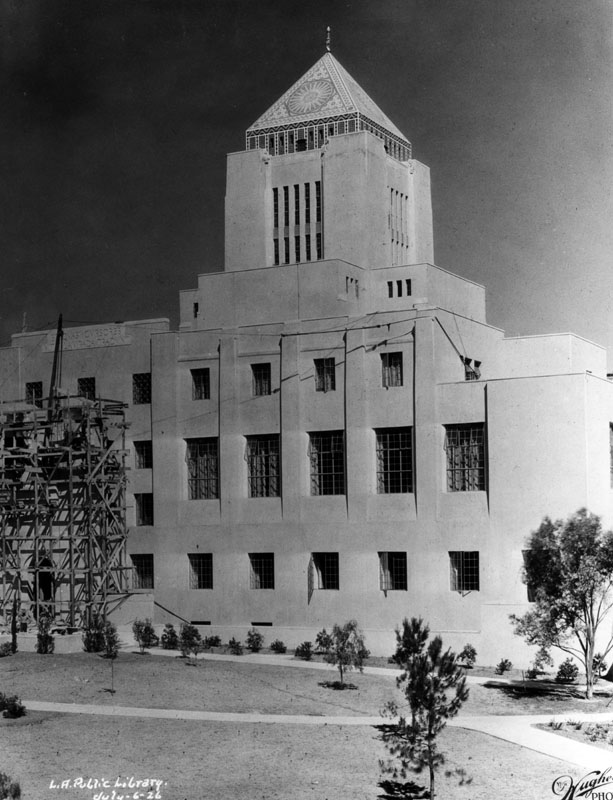
Central Library Mosaic Dome

In honor of the 25th anniversary of the library fire, today's mosaic is a survivor of the blaze: the mosaic dome atop the 1926 structure.


Here's a paragraph from both Tribes.tribe.nethttp://tribes.tribe.net/lacentrallibrary and Wikipedia describing it:


Architect Bertram Grosvenor Goodhue designed the original Los Angeles Central Library to mimic the architecture of ancient Egypt. The central tower is topped with a tiled mosaic pyramid with suns on either side with a hand holding a torch representing the "Light of Learning" at the apex. Other elements include sphinxes, snakes, and celestial mosaics. It has similarities to the Nebraska State Capitol in Lincoln, Nebraska, also designed by Goodhue and which also featured sculpture by the architectural sculptor Lee Lawrie.

The library itself has a page on its art, but I could find nothing about the dome. However, they do have an incredible archive of dozens of pictures taken during construction in 1925 (top right) and 1926 (bottom right.)

And dang, all the color pictures I find of the mosaic are so washed out I don't want to use them. The exception at top is from the VigilantCitizen blog, which writes about symbolism on our public places. That post also includes extensive biographies of Goodhue and the artists who contributed to the library, as well as a discussion of the symbolism of the tower mosaic--mostly focused on the pyramid and the sun.

Friday, April 29, 2011

The Library Fire: 25 Years Ago

The Los Angeles Library Facebook page carried this picture--I sure would not have remembered otherwise. April 29, 1986, was the day that an arson fire broke out just before 11 AM at the mail library on 5th Street. By 5 PM, 60 units and 350 firefighters were involved.

You can read a blow-by-blow description of the fire at the LAFD Historical Society website, or at the LAFD Historical Archive.

Here's a sample: "As the heat and fire crept through the building, fire attack companies were forced to withdraw and be replaced every 15 minutes. Every time a hose line was opened up inside, super-heated steam pushed the fire attack company back."

In the end, 350,000-400,000 books--$20 million worth--were destroyed outright. Water and smoke damaged more. Still, according to the LAFD Historical Archive, 8.5 million books were saved.

Was the arsonist ever caught? I think not.

Wednesday, April 27, 2011

Googie Road Trip!

To honor Eldon Davis' passing, James Horecka posted his Googie Road Trip slide show--complete with maps--on the Hidden Los Angeles Facebook feed. Bob's Big Boy, Pann's, the former Wich Stand, the LAX Theme Building, all pretty and refurbished...There's even a new (2009) site in the mix.

And because I missed Mosaic Monday this week, I'm illustrating this announcement with one of the pictures in the slide show, used with permission: the "N" mosaics that decorate Norm's Restaurant at 470 N. La Cienega. The firm of Armet and Davis designed this in 1957.

Monday, April 25, 2011

Eldon Davis Passed Away

Eldon Davis, who helped define Googie architecture in LA with buildings like Pann's Restaurant and classic Norm's Coffee Shops, passed away this weekend at age 94. Read a heartfelt tribute at Chris Nichols' blog (with Los Angeles Magazine).

Imagine dying at 94 "after a brief illness". Here's to great health, longevity, and doing what you love for a living.

Wednesday, April 20, 2011

April 30--L.A. Stories

Sunday, April 30, from 11am to 3pm, KCET and the Mayor's Office is co-sponsoring an event at Rio de Los Angeles State Park. And holy cow, there's even a mosaic bench there.

The event is called StoryShares; the day is also Mayor Villaraigosa's Day of Service.  Food, festivities, Hiz Honor, and the band Ozomatli will all be present--fresh from Coachella and Napa, in the case of the band.

The point is collect stories about the people who live by the Los Angeles River. Your story. You can go online and fill out a form on how you enjoy the river, or wait for the Sunday event, where--if I understand rightly--there will be audio and video recording of memories going on. 

That same weekend, though, is the Los Angeles Times Festival of Books at USC, with hundreds and hundreds of authors and celebrities. People like Lisa and Carolyn See, Vincent Bugliosi, Steve Lopez, Jamie Lee Curtis (must be a memoir there), Jennifer Egan (PULITZER PRIZE WINNER!), Janet Fitch, etc. etc.

Tuesday, April 19, 2011

St Catherine Laboure Mosaic and Windows

It's big, it's sparkly, and it's even (I think) ecumenical, if that word means universal. The mosaic sits behind the altar at St. Catherine Laboure Catholic Church in Torrance, on Redondo Beach Blvd.--near El Dorado Park and El Camino College.

According to a 1977 Los Angeles Times article, the work was done by  two sisters, Edith and Isabel Piczek--born in Hungary, educated all over, but living in Los Angeles. At the time of the article, their religious art and stained glass windows adorned 158 churches in seven countries.

PublicArtinLA credits Isabel with "The Annunciation," a mosaic over the doorway of Our Lady Queen of Angels Church (the Plaza Church).

The crowning achievement of the Piczek sisters seems to be Las Vegas' Guardian Angel Cathedral. The building itself is eye-catching an innovative, but the mosaics and stained glass are truly amazing. Here's an article with pictures about that church.

At St. Catherine Laboure, the Piczek sisters also created eight stained glass windows, according to the Times.  One of them must be this picture from the church's website.

I took pictures of the stained glass windows in the front of the church because they were very different--they look rather 1950s to me. I'm pretty sure these are not the work of the Piczek sisters.

A friend told me these windows were actually made and installed in the 1980s by a parishioner who was grateful to the Church and simple made an artistic gift of it, doing the work himself.

Here are the pictures; maybe someone knows more about their origin. The outside shot on the left came out rather well, especially if you click on it to see all the detail. The inside shot of the top of the same window...not so good. I tried both morning and afternoon, but the church faces north and the light was just too bright.

Still, you can see that it doesn't look at all like the work of Isabel and Edith Piczek. Can you believe that there is no Wikipedia entry for these incredibly skilled and prolific artists?

Monday, April 11, 2011

Return to Redondo Beach Mosaic-s


The nice thing about mosaics is that we are never truly finished with them.

This weekend, Patch in Redondo Beach posted my article about the restoration work being done on a mosaic pictured at left. Art conservators are working on the 18- or 20-foot wide mosaic by Susan Hertel which went up in 1979. The bank is now a Wells Fargo (it started out as a Home Savings & Loan), and Wells Fargo committed to restoring the mosaic last September, when my first Patch article ran.

So far so good.

The big surprise, when I stopped by on Sunday to see the work, is that a second mosaic was hiding in sort-of plain sight: over an unused door in the back of the bank, facing a tiny stucco building called the Cozy Cafe. Here's a picture at right.

You can see the deterioration--it's even worse than the front mosaic. On the far left, a big chunk of tiles is missing.

The good news is that the replacement tiles--left over from the original installation--are available. I keep trying to tell Wells Fargo this. The bad news is they're not using them--but for a good, ethical reason. They want the restoration work to be clearly visible when viewed up close.

I understand, but I hope they change their mind about using the original tiles. I mean, it's practically miraculous that they are available after 32 years, and miracles should never be ignored.

As for the cafe next door--it's been there since the 1940s. Why would Home Savings put a big, beautiful mosaic where it can't be seen because of another building?

Well, once the article went up we learned a partial answer. Tony Czulager of Redondo Beach remembered that this building was brought in pre-fabricated and was intended to be temporary.

Apparently Home Savings was certain that Cozy Cafe would move and they could have its land and parking lot. They'd raze the cafe and put in a new, larger, Home Savings.

Perhaps the mosaic was intended to ornament the new, main entrance at that point.

Didn't work that way. As Tony pointed out, the Cozy Cafe is still there, still serving breakfast around its counter as it has for sixty-five years, and Home Savings is very gone.

Wonder if there are other 'pre-fabbed' Home Savings?

Sunday, April 10, 2011

A New Outlet for Local History Writers

The History Press is looking for authors.

The History Press is adding California to its line of local history books. They're looking for people to write text-driven books of about 30,000-40,000 words, accompanied by at least 30--and hopefully more--photographs.

Sound like Arcadia? I thinks so too. Like Arcadia, they neither give advances nor do they charge the authors any fees. You propose the topic--local history can be told through stories of neighborhoods, sports, haunted sites, or even tales of true crime. History Press has a series for each of those topics--or food & drink, local legends, you name it.

And since they're new to California, I assume they're wide open to ideas. As far as I could tell, the only Southern California titles that are scheduled (not published yet) are about Del Mar and Orange.

I'm going to assume that--like Arcadia--this offer is not something you'd do for the money. No, the reward would be seeing your book, or your community's book, out on shelves.

There's a big form to be filled out if you are interested in publishing with The History Press--under the "For Authors" tab at their site.

Monday, April 4, 2011

Coronado Bay Playhouse

This mosaic sits outside a building labled: City of Coronado Community Playhouse.

It's actually the Coronado Playhouse, a 64-year-old institution which has occupied its present locale on Glorietta Bay since 2006. Before that, the playhouse operated in a high school auditorium, a quonset hut, and even a temporary "strung" structure--a pavillion.

The mosaic is titled "Sea Passage" by artist James T. Hubbell. Commissioned by the City of Coronado, it also has a less romantic name: Glorietta Bay Linear Park Artwork.

In 2007, the Port of San Diego gave the work its Orchid Award for Excellence in Public Art.

The Port of San Diego's Public Art program seems to be huge and well-funded, and there are mosaics all over the place down there--sea walls, schools, raised dividers at public intersections. Just sayin', while this will be my last bow to San Diego (at least till my next weekend trip), someone could power a blog for quite a while by taking pictures of all the lovely artwork in the area.